
STEMMA
Systems of Transmitting Early Modern Manuscript Verse, 1475-1700
College of Arts, Social Sciences & Celtic Studies School of English and Creative Arts
College of Arts, Social Sciences & Celtic Studies School of English and Creative Arts
One of the most striking things that the STEMMA dataset has revealed about surviving texts in early modern English manuscripts is the sheer number of poems which appear to survive in only a single manuscript witness. To date, there are 37,540 unique poems—more than a third of the total number of manuscript witnesses we have, based on our source indices. In the process of identifying these unique items, we have found discrete groups of unique verse. One that caught my interest was a set of lines, all labelled ‘Posies’, which span several pages of British Library MS Harley 6910. The folios containing them are divided into tidy columns, each of which has a running list of single-line and double-line posies: short poems often carved, engraved, embroidered, or otherwise applied to jewellery and household goods. This list is quite well known to historians of Elizabethan and Stuart jewellery. Joan Evans relied on it in his foundational study of English posy rings. Harley 6910, along with a manuscript now at Lambeth Palace Library, and three other manuscripts in private hands, account for all of the manuscript lists of posies underpinning Evans’ collection of some 3000 posies.
A further search in the STEMMA dataset has turned up several additional sources, some unique, and others not. It raises questions about how a scribe might shift the boundary between poetry and posy. The varying ways that cataloguers and archivists have approached lists of posies may account for some of the apparent uniqueness of some. In certain cases, only the first line of a group of posies has been catalogued. This, in turn, raises questions about where posies fall in view of manuscript poetry. Would a list of posies have been considered a ‘professional’ text assembled by members of the Goldsmiths’ or Broderers’ guilds? Could looking for large groups of unique texts lead us to similar collections of verse related to the daily work of various trades, and if so, might that help expand conversations surrounding the readers, writers, and collectors of verse in early modern England?
Regarding the line between poetry and posy, the posy-poems by George Herbert and William Strode offer an interesting look at how poets used the posies as a vehicle for elevating their own poetry. Herbert plays on the familiarity of posy to comment on the interplay between the material, spiritual, and literary culture surrounding him. His poem is structured like a series of short posies, but the lines cannot be isolated into discrete parts.
Let wits contest,
And with their words and posies windows fill:
Less than the least
Of all thy mercies, is my posie still.
This on my ring,
This by my picture, in my book I write;
Whether I sing,
Or say, or dictate, this is my delight.
Invention rest,
Comparisons go play, wit use thy will:
Less than the least
Of all God’s mercies, is my posie still.
Herbert effectively mimics the form of printed posy books, but does so in a rejection of showiness and wit. Only surviving in three manuscript witnesses, it is eclipsed by the popularity of William Strode’s series of ‘posies’, these being ostensibly intended for necklaces, bracelets, ear strings, and the like. Much like in the printed chapbooks that tradespeople might use to find rhymes for their wares, he lists a series of items and offers a set of rhymes for each, playing on both the material of the adornment, the parts of the body it was meant to decorate, and the means of attachment. When copied into manuscript verse collections, the presentation of the lines risks loss of structure and restructuring, affecting the interplay between the genres.
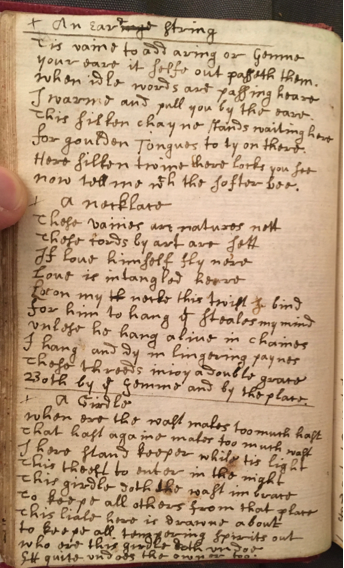
British Library Add. MS 30982, f. 12v.
In British Library Add. MS 30982, the scribe groups all the lines as if it is a single poem, with variation in alignment and no punctuation. This is consistent with most of the poems in the manuscript, where the words are copied with no attention to incidentals. The effect is a series of poems running far longer than would be easily engraved on a piece of jewellery, divorcing the poem from the genre on which it comments. The arrangement of the poems in Folger MS V.A.245 cleverly fragments them. In this manuscript, the scribe uses indentation and marks to indicate ‘endings’ to partly isolate each rhyming group.
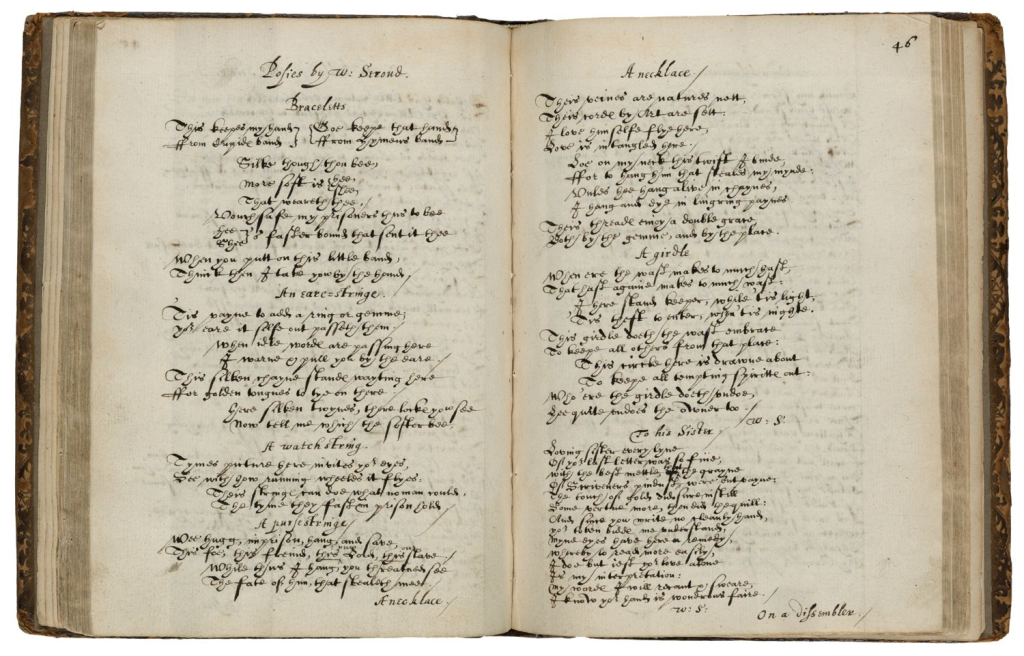
Folger Shakespeare Library, MS V.a.245, ff. 45v-46r.
What in Add. MS 30982 appears to be a poem collecting the sentiments of engraved posies, in V.a.245 instead is presented at the very least a poem with clear divisions. The scribe’s rendering of it breaks the flow of reading, thereby creating this lovely tension. The presentation in a calligraphic hand, surmounted by an attribution to Strode and surrounded by other poems by him, is tempered by the almost functional framing of the lines, with bracketed variants for each gender.
Braceletts
This keepes my hand} {Goe keepe that hand
from Cupids band} {ffrom hymens band
Silk though thou bee,
more soft is {hee {shee
That weareth thee.
Vouchsafe my prisoner thus to bee
{hee’s {shee’s faster bound that sent it thee
When you putt on this little band,
Think then I take you by the hand.
An Eare=stringe
This vayne to add a ring or gemme;
yor eare it selfe out passeth them./
When idle words are passing here
I warne and pull you by the eare/
This silken chayne stands wayting here
ffor golden tongues to lie on there./
here silken twynes, there locke yow see
now tell me which the softer here.
A watchstringe.
Tymes picture here invites yor eyes,
See with how running wheeles it flyes:
Thies string can doe what no man could,
the tyme they fast in prison hold./
Strode’s use of identifiably discrete posies, grouped by item into full poems, becomes a nuanced play on the relationship between the body, the giver, the text, and the material adornment, all of which display his superior skill as a poet. He seems to have been successful, as the poems survive in at least ten manuscripts. Posies in the sense with which Herbert understands them do not seem to have circulated widely. A small collection of posies appears in Folger MS V.a. 307 (f. 65r-v). A curious list of ‘Posies for Trenchers’, all of which are appropriately long and largely bawdy, is included in British Library Add. MS 25707. Neither seems connected to any other surviving manuscript witness. Within STEMMA’s dataset, I have only identified one pair of manuscripts with what appear to be several genuine shared posies. Huntington Library MS HM 172 and Folger MS V.a.505 include four ‘double posies for rings’, all amorous in subject. To date, these are the only posies I have seen which circulated without having any connection to a noted poet.
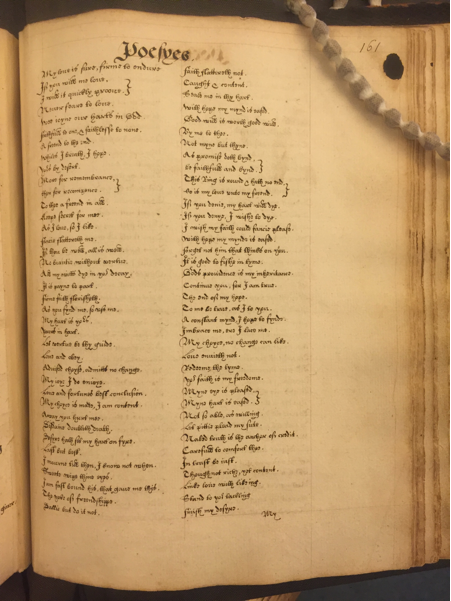
British Library MS Harley 6910, f. 161r
Returning to Harley 6910, the list within it also sets it apart from these other groups. The list includes lines for love, friendship, and mourning, whereas the smaller groups I have encountered in other manuscripts include only amorous verses. It also repeats entries occasionally. The most compelling feature of the list is that it rarely overlaps with any of the seventeenth-century printed sources. Furthermore, several surviving rings bear inscriptions only recorded in this manuscript. While many of the recorded poems in Evans’ book use a fairly small set of similar words, the surviving jewellery with connections to Harley 6910 has unusual posies. One, inscribed ‘chastitie is a jewell’, makes for a decidedly odd message to send a friend or lover—the typical recipients for posy rings. Unlikely as it may be, it is intriguing to consider whether there might be some information about the compiler encoded in the manuscript through the inclusion of this list. Harley 6910 is first and foremost a verse collection, so that context and the lack of any sort of categorisation of the posy lists would seem odd for a goldsmith’s working list. By including the catalogue of posies in the miscellany, however, the scribe elevates the texts above the fodder for a poorly printed chapbook. In that sense, there is a sort of reframing of ‘professional’ texts that also occurs in other manuscripts.
Returning to the idea that large groups, or even large percentages of unique verses, might point towards professionally aligned texts, another manuscript that I came across while working with the dataset, shows an interesting parallel. Folger MS V.a.311, the fantastic emblem book of draper, merchant, and writing master Thomas Fella, includes a collection of 83 verses, of which 23 are unique. Much of the remaining verse is copied from the emblemist Geoffrey Whitney. The poems in Fella’s book serve their traditional, emblematic purpose, being instructive on various moral and spiritual themes. His arrangement of them, interspersed between poems by the renowned Whitney, and combined with his own excellent drawings, elevate the work of the writing master to poet and artist.
Taking the reasonable assumption that highly-specific unique poems about persons or places might help us identify communities engaged in reading, writing, and collecting poetry, it is interesting to consider how professions outside of the typical centres of literary culture might be reflected by collections of posies and related texts.
Joan Evans. English Posies and Posy Rings. London: Oxford University Press, 1931, p. xxliii.
For examples of printed chap-books, see:
Cupids Posies for Bracelets, Hand Kerchers and Rings, with Scarfes, Gloves and Other Things. Early English Books Online. For Iohn Wright and are to be sold at his shop in the Old-Bailey, 1642. http://gateway.proquest.com/openurl?ctx_ver=Z39.88-2003&res_id=xri:eebo&rft_val_fmt=&rft_id=xri:eebo:image:187859.
Loves Garland, or, Posies for Rings, Hand-Kerchers & Gloves and Such Pretty Tokens That Lovers Send Their Loves. Early English Books Online. Printed by Andrew Clark, 1674. http://gateway.proquest.com/openurl?ctx_ver=Z39.88-2003&res_id=xri:eebo&rft_val_fmt=&rft_id=xri:eebo:image:43570.
Geffrey Whitney A Choice of Emblemes, and Other Deuises, for the Moste Parte Gathered out of Sundrie Writers, Englished and Moralized. And Diuers Newly Deuised, by Geffrey Whitney. A Worke Adorned with Varietie of Matter, Both Pleasant and Profitable. Early English Books Online. In the house of Christopher Plantyn, by Francis Raphelengius, 1586. http://gateway.proquest.com/openurl?ctx_ver=Z39.88-2003&res_id=xri:eebo&rft_val_fmt=&rft_id=xri:eebo:image:20607.