
STEMMA
Systems of Transmitting Early Modern Manuscript Verse, 1475-1700
College of Arts, Social Sciences & Celtic Studies School of English and Creative Arts
College of Arts, Social Sciences & Celtic Studies School of English and Creative Arts
Leah Veronese
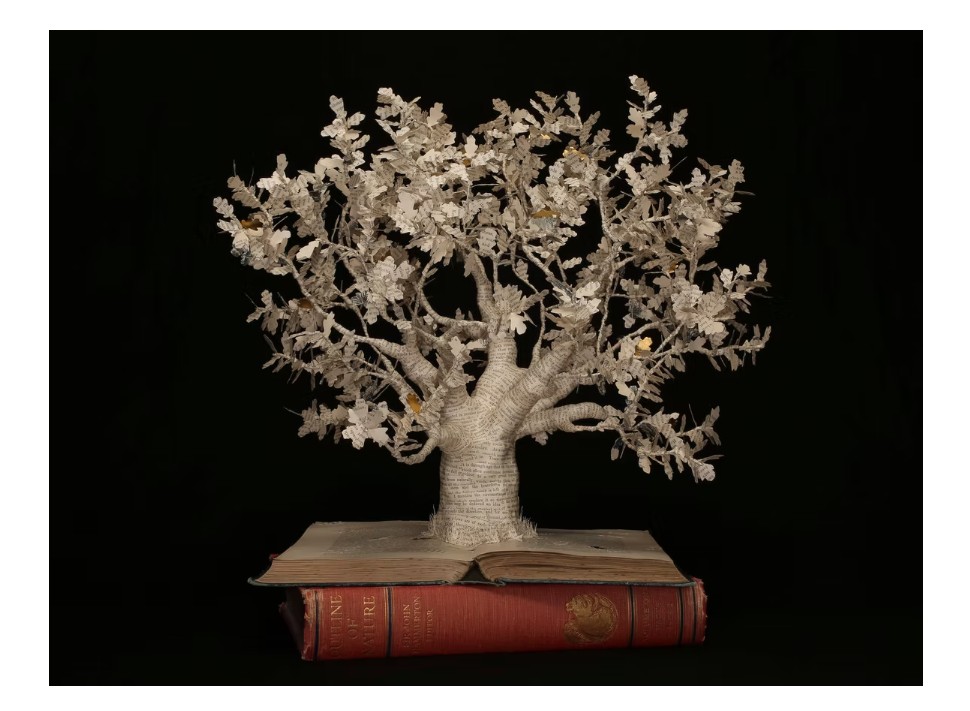
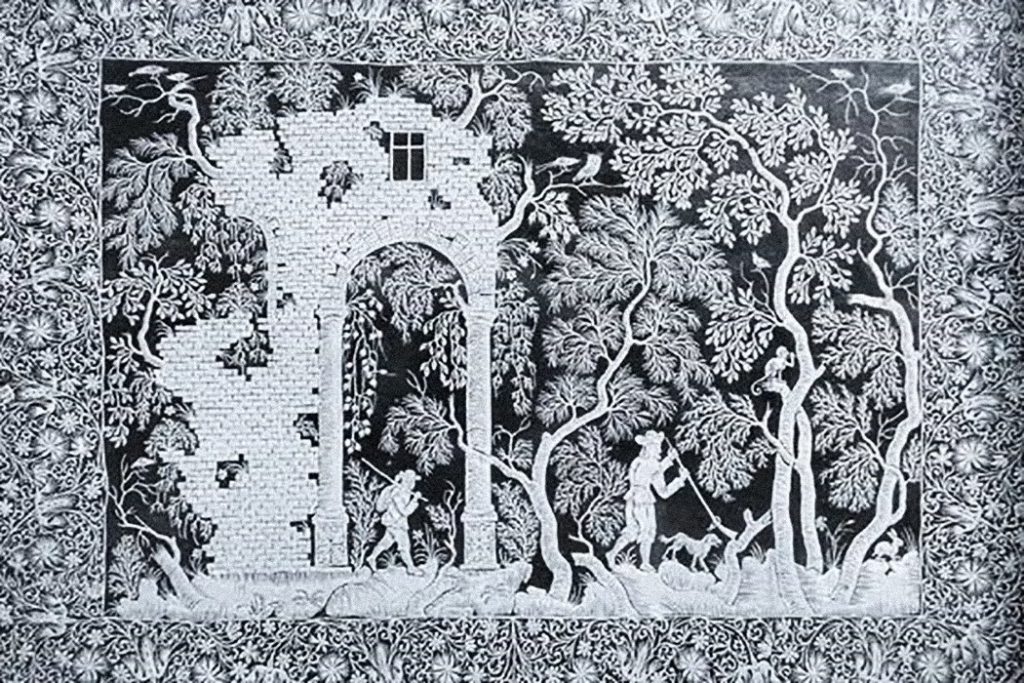
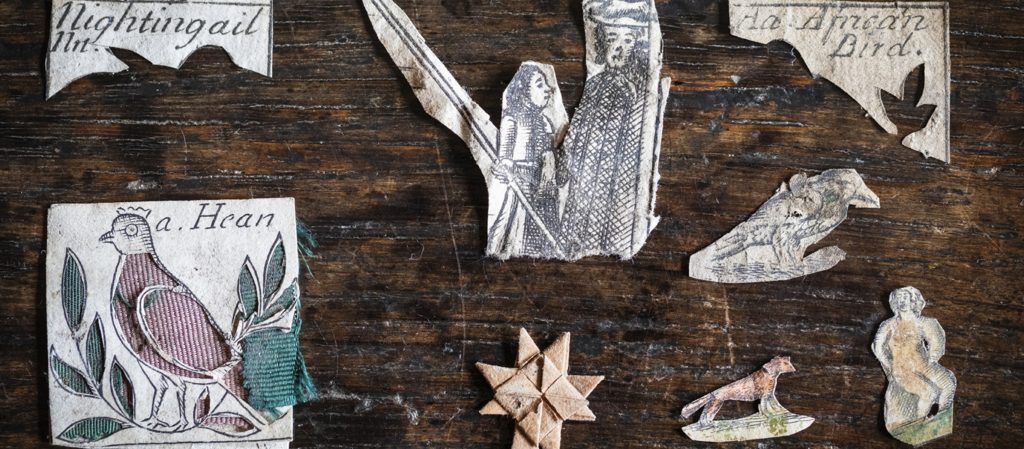
The enchanting tiny worlds of modern recycled book-sculptures are the descendants of early modern paper crafts. In the late-seventeenth century women were engaged in similar arts of collage and paper sculpture: from cutting out printed images and arranging them into compositions such as the examples recently discovered under the floorboards of Sutton House, to the intricate cut paper scenes of artists like Joanna Koertens. [1] When it comes to trees in particular, the Arts Treasury (1688) recommended decorating wax model trees with paper leaves ‘in case of the Leaves of green Trees, they may be Paper or Horn, thin and finely coloured, shaped and wisted upon wiers’, and the Musæum Tradescantianum (a catalogue of the collection of John Tradescant and his son) boasted a collection ‘of trees… cut in paper’. [2] These paper crafts are celebrated in Edmund Waller’s poem ‘To the Lady Isabella Flynn on Her exquisite Cutting trees in paper’.
One of the compilers of Bodleian MS Rawl. poet. 84 copied Waller’s poem in close proximity to William Cartwright’s poem praising the embroidery of Lady Elizabeth Powlet, drawing these two similar poems into conversation. This blog takes up their invitation to compare the two poems. Cartwright’s poem praises Elizabeth Poulet’s real gift of embroidered scenes of the nativity and the crucifixion which she gave to the University of Oxford in 1636. [3] Early modern scholars such as Susan Frye have demonstrated that early modern women’s embroidery was frequently compared with, and understood stood as another form of, literary creation. [4] Both these poems form part of this tradition.
Bodleian MS Rawl. poet. 84 is a miscellany from the mid to late seventeenth century, containing three hands. Waller and Cartwright’s poems are copied in the same hand. An ownership anagram by Frances Pawlett might suggest a connection between the manuscript and the Pawlet family. [5] The collection as a whole revels in material culture, from a fly-leaf poem comparing man to the fate of quickly circulating, inflammatory pamphlet, to poems on a lover’s gift of gloves, and a fond farewell to a threadbare cloak. [6] The latter two poems are written in the same hand as the Waller and Cartwright’s poem. This compiler appeared to particularly enjoy ekphrasis, (the literary description of objects or paintings), copying out several other poems about paintings. [7] Waller and Cartwright’s poems on paper cut trees and embroidery fall into this category, and might suggest the compiler’s interest in poems celebrating female craft. One of self-conscious ironies of ekphrastic verse is that writers frequently declare the superiority of visual art over writing, whilst carefully linguistically crafting the description of the art-object. This irony is present in both poems, however, with the additional gendered dimension of male poets praising female crafts.
Both poets present the women’s craft as a reflection of their chastity. For Waller chastity is related to the material process of the craft:
Fayre hand that canst on virgin paper write
Yet from the stayne of ink preserve its white
Whose travails o’er those silver plaines doe shew
Like tracks of Leverets in morning snow
Waller draws on the early modern trope of the staining of paper with ink as the defiling of a woman. Lady Flynn’s art of cutting paper allows her the creative force of writing without blemishing the paper. Waller does not care to extend the metaphor by considering the violence of slicing through a paper surface. The lack of ink might also practically suggest that her paper trees were more in the style of Koerten’s cut paper scenes rather than cut-out printed illustrations like the Sutton House papers. In one of the most beautiful images in the poem, Waller describes Lady Flynn’s efforts as imperceptible as the footsteps of baby hares (leverets) ‘in morning snow’. Waller presents this paper craft as the renaissance ideal of sprezzatura, seemingly effortless art. He simultaneously evokes Lady Flynn’s labours, her ‘travails’ upon the paper (‘Physical or mental work, esp. of a painful or laborious nature; great effort or exertion’, OED, n1, sense 1a), but also suggests her touch is so light that only traces of it can be glimpsed. The baby hare’s footprints are also a form of cut, their little paws lightly slicing the snow.
For Cartwright Lady Powlet’s chastity is reflected by her choice of subject matter. Halfway through the poem Cartwright reveals the religious subject matter at the heart of Lady Powlet’s embroidery: the nativity and the crucifixion. Cartwright praises this choice of composition, surpassing the chastity of Homer’s Penelope with Christian piety: ‘Tell me not, of Penelope we do/See a webb how more chast[e], and sacred too’. The poem then takes a misogynistic turn as Cartwright derides other women’s romantic choice of subject matter:
Where are yee now O women! Yee that sew
Temptations lab[our]ing to express ye bow
And ye blinde Archer, ye that rarely set
To please your Loves a Venus in a nett
Like Waller’s emphasis on Lady Flynn’s sprezzatura, Cartwright compares both the effort and the motivation of Lady Powlet in contrast to other female embroiderers. Whereas Lady Powlet’s art is an expression of her piety, other women exert themselves, ‘lab[ou]ring’ to tempt their audience rather than to edify them. Ironically, in reality, biblical scenes make up nearly half of the surviving examples of early modern women’s embroidery. [8]
Continuing the comparison between other the siren embroiderers and Lady Powlet’s devout craft, Cartwright closes the poem with almost Marian praise of Lady Powlet: ‘Women sewed Idle fig leaues hitherto/Eves nakedness is onely cloathed by you’. Cartwright echoes the Catholic tradition of the Virgin Mary as the exceptional woman who redeemed Eve’s Fall. Other women’s embroidery become the ‘fig leaves’ with which Adam and Eve attempted to cover their nakedness after the Fall – presumably evoking the leafy patterns of embroidered designs as well as the figurative sense of the fig leaves in Eden. Seemingly Lady Powlet alone can redeem Eve’s shame through the awesome power of some nice embroidery. And yet this strange metaphor carries its own unavoidable baggage: Lady Powlet’s embroidery is still represented as a form of clothing, integrally tied to this biblical moment of self-consciousness and guilt.
Both Waller and Cartwright represent the female crafts both as comparable with, and (in theory) superior to, literary creation. Waller beautifully imagines Lady Flynn breathing a little storm through her paper forest:
Whose breath salutes there new created grove
Like southerne windes, and gently makes it move
Our shews could make the forrest dance but you
Can make the mot[i]on and the forrest too
A Poets fancy when he payntes a wood
(By his owne nation onely vnderstood)
Is as in language, so in forme confined
Not like to yours acknowledg’d by mankinde
All that know nature or the trees that grow
Must prayse the foliage expres’d by you
Whose hand is reade where ever shew are men
Poets can enliven fictional worlds with figurative language – ‘make the forest dance’ with personification, but Lady Flynn can both physically create her world and bring it to life with movement. Waller echoes God breathing life into Adam as Lady Flynn breathes her forest into dynamism. Of course, in the process he elegantly demonstrates his own linguistic skill. He does, however, gesture to the universal power of visual images in comparison to nationally-bound limitations of language. But Waller is reluctant to truly leave language behind, making her paper trees an extension of her handwriting (‘whose hand’) which can be ‘read’.
In Cartwright, given the religious subject matter of Lady Powlet’s embroidery, the question of the superiority of text or visual art allows him to evoke the Reformation controversy about art and idolatry (the rejection of religious art as blasphemous). Cartwright flirts with the idea that Lady Powlet’s embroidery might be a better tool for a conversion than text: [9]
Nor can the stile be prophanation when
She needle may convert more yn ye pen
When fayth may come by sewing and each leafe
Rightly peru’sd prove Gospell to the deafe
He carefully, however, couches this by ultimately making her embroidery another form of text which can be ‘rightly peru’sd’ just as Lady Flynn’s trees can be ‘read’. Cartwright strikingly describes how Lady Powlet’s embroidery provides ‘a transcript’ into Christ’s mind: ‘Then on ye crosse such loue, such greife we finde/As there a transcript of our sau[iou]rs minde ‘. Given the textual nature of ‘transcript’ (‘a written copy’, ‘a verbal or close translation’, OED, sense 1a and 1b), Lady Powlet’s embroidery becomes an act of incarnation: the word becomes thread rather than flesh. Likewise, Cartwright describes how the thread used in the manger becomes infused with Christ’s nature ‘View we ye manger of ye babe, we thence/Beleiue ye way threads haue innocence’.And yet the flesh also becomes word, the ‘transcript of our sau[iou]rs minde’ miraculously turns Lady Powlet’s embroidery into a Christ’s own words – perhaps the highest compliment that could be given to a devout early modern embroiderer.
[1] Although there does seem to be a gendering to these particular activities, early modern men also engaged in collage such as the delightful commonplace book of Sir John Gibson (British Library Additional MS Add MS 37719).
[2] Arts treasury, (London, 1688), p.115. Musæum Tradescantianum, (London, 1656), p.58.
[3] Lady Powlet’s gift appeared to be a popular subject for poets of New College, Cartwright’s poem appearing in a manuscript of dedicated to Elizabeth Powlet, praising her embroidery (MS Bodl. 22). Claire Canavan and Helen Smith, ‘“The needle may convert more than the pen”: women and the work of conversion in early modern England’ in Conversions: Gender and Religious Change in Early Modern Europe, ed Simon Ditchfield and Helen Smith, Manchester: Manchester University Press, 2017: 119.
[4] Susan Frye, Pens and Needles: Women’s Textualities in Early Modern England, Philadelphia, University of Pennsylvania Press, 2010.
[5] Nora Rodríguez‑Loro, ‘Paris’s Choice (1670) by Charles Davenant:A Seventeenth‑Century Play Preserved in a University Manuscript Miscellany’, Neophilologus, Vol.106, 2022, pp.683–727: 687.
[6] See flyleaf, Fol.95v, Fol.76r.
[7] See Fol.91v, Fol.94v.
[8] Canavan and Smith, 2017: 113.
[9] For the representation of conversion in the poem see Canavan and Helen Smith, 2017, pp.119-121.
